The Ultimate Guide to Converting Metric and Imperial Units in Everyday Life
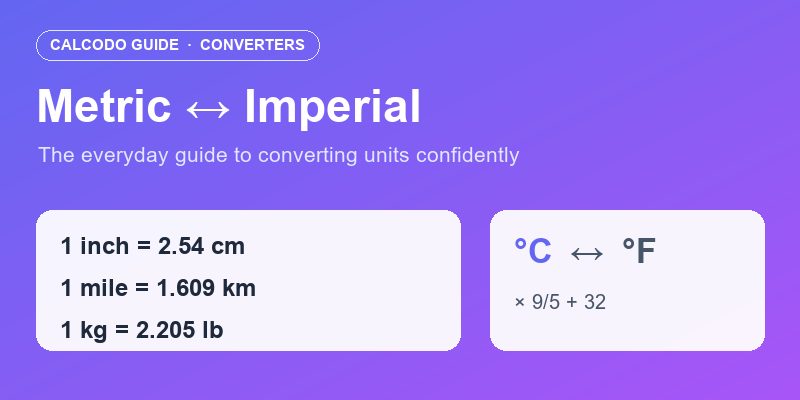
While almost the entire globe has standardized on the metric system, the United States remains firmly entrenched in the imperial system (US Customary Units). Because of the deeply integrated nature of global commerce, internet recipes, and international travel, bouncing between these two systems is an unavoidable part of modern life.
Common Temperature Conversions: Fahrenheit vs. Celsius
If you're an American traveling in Europe, seeing a weather forecast of "30°" might prompt you to grab a heavy winter coat, when in reality, it's a scorching hot beach day. Conversely, setting a European oven to 350° (thinking of Fahrenheit) will incinerate your dinner.
A quick mental approximation to go from Celsius to Fahrenheit is to double the Celsius number and add 30. For exact precision, use our Temperature Converter.
Weight in the Kitchen and the Gym
When reading international fitness blogs or recipes, you frequently see Kilograms (kg) and Grams (g). The mental math here is straightforward:
- 1 Kilogram is exactly 2.204 pounds. So to convert kg to lbs, just multiply by 2.2.
- 1 Ounce is about 28 grams.
If you're dealing with precise dosages or delicate baking ratios, you shouldn't rely on mental approximations. Bookmark our Weight Converter for instant accuracy.
Distances and Lengths
Renting a car abroad? You'll be driving in Kilometers per Hour (km/h) rather than Miles per Hour (mph).
- 1 Mile = 1.6 Kilometers. A 100 km/h speed limit means you should be driving around 62 mph.
- 1 Meter = 3.28 feet. A 2-meter tall person is about 6 foot 6 inches.
For DIY home projects calling for centimeters and millimeters while your tape measure is in inches, run the numbers through our Length Converter to prevent costly mis-cuts.