Sales Tax vs VAT: Why the US and Europe Price Things Differently
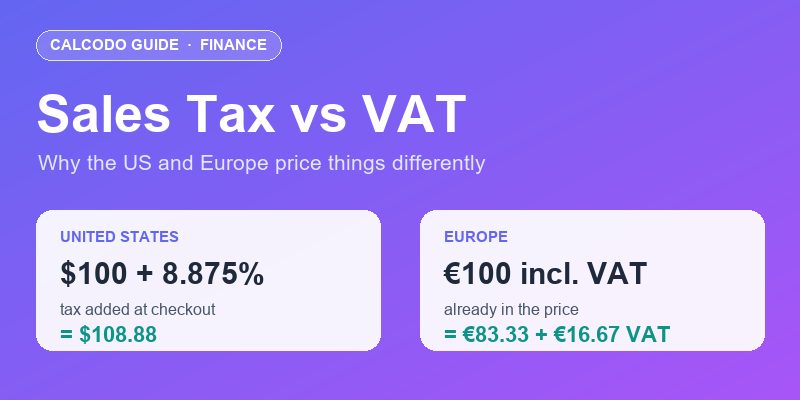
A 100 dollar jacket in New York costs 108.88 dollars at the register, once the 8.875 percent combined state and city sales tax is added. A 100 euro jacket in Berlin costs exactly 100 euros at the register, because Germany's 19 percent VAT is already inside the price. Same product, same sticker price, different math - and if you shop, sell, or move between the US and Europe, the difference matters.
US Sales Tax: Added at Checkout
Sales tax is added at the point of sale, and the rate depends on where you are. There is no federal rate: states set their own, counties and cities pile local tax on top, and the combined rate can differ between neighbouring towns. Four states - Delaware, Montana, New Hampshire, and Oregon - levy none at all, while combined rates elsewhere run past 9 percent. The formula:
Run the math for any state and local combination with our free Sales Tax Calculator - it also strips tax back out of a receipt total, which is what bookkeeping needs.
European VAT: Already in the Price
VAT (value-added tax) is collected at every stage of production but displayed inclusive, so the shelf price is the final price. Standard rates across Europe: UK 20 percent, Germany 19 percent, France 20 percent, Italy 22 percent, Spain 21 percent, Ireland 23 percent. Reduced rates apply to groceries, books, and medicines.
The step people get wrong mentally: VAT is 20 percent of the net, not 20 percent of the gross. Split any invoice or receipt correctly with our VAT Calculator (UK 20, Germany 19, Ireland 23, and custom rates).
Which System Costs Shoppers More?
Neither, mechanically - a 20 percent VAT and a 20 percent sales tax produce the same final number. The difference is visibility and base: sales tax is quoted on the pre-tax price (so the sticker understates the total), while VAT is quoted on the tax-inclusive base. For businesses the mechanics differ far more: US sellers remit tax only on their retail margin jurisdiction by jurisdiction, while EU businesses charge VAT on nearly every sale and reclaim the VAT they paid on inputs - which is why invoice software on each side of the Atlantic looks so different.
Quick Reference
- US: added at checkout, rate varies by state + locality, 4 states have none.
- Europe: included in the price, one national rate per country plus reduced rates.
- Removing tax from a receipt: divide by (1 + rate). Adding: multiply by (1 + rate).
- Cross-border shoppers: price tags in Europe are final; in the US, budget roughly the local combined rate on top.