Mastering the Math: How to Calculate Percentage Increase
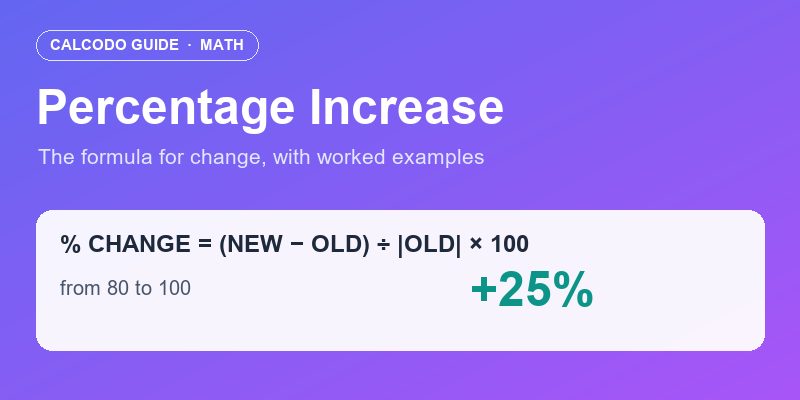
Percentage increase is a concept we encounter almost daily. From the rising cost of groceries to the growth of an investment portfolio, knowing how to quantify change as a percentage gives you incredibly valuable context that raw numbers alone cannot provide.
The Formula for Percentage Increase
Calculating the percentage increase between two numbers requires a simple three-step formula:
Step-by-Step Example
Let's say you bought a share of stock for $40 (your old value). A year later, the stock is trading at $55 (your new value). What is your percentage increase?
- First, find the absolute difference (the amount of change): $55 - $40 = $15.
- Next, divide that difference by the original old value: 15 / 40 = 0.375.
- Finally, multiply by 100 to convert the decimal to a percentage: 0.375 × 100 = 37.5%.
Your investment grew by 37.5%!
Common Pitfalls: Changing the Base
A common mistake people make is dividing the difference by the new number instead of the old number. Always remember: percentage change is universally measured relative to where you started, not where you ended up.
If you don't want to perform the manual arithmetic—especially when dealing with messy decimals or massive numbers—you can use the "% Change" mode on our Percentage Calculator to get instant, error-free results. Additionally, if you are strictly calculating investment yields over time, our Investment Return Calculator provides a detailed breakdown including annualized growth.